
What to Drink with Your Dinner at Vito's: A Guide to Italian Wine Pairing

Italian wine and Italian food grew up together. The grapes, the soil, the regional cooking traditions, all of it developed in the same places over the same centuries. That history is why Italian wines tend to work so well with Italian food in a way that wine from other countries sometimes does not. The acidity is higher, the tannins create more grip, and the flavors are built to cut through olive oil, tomato, and aged cheese rather than stand apart from them.
You don't need to know much about wine to find a pairing you'll love. A few reliable principles will take you most of the way through a menu like Vito's.
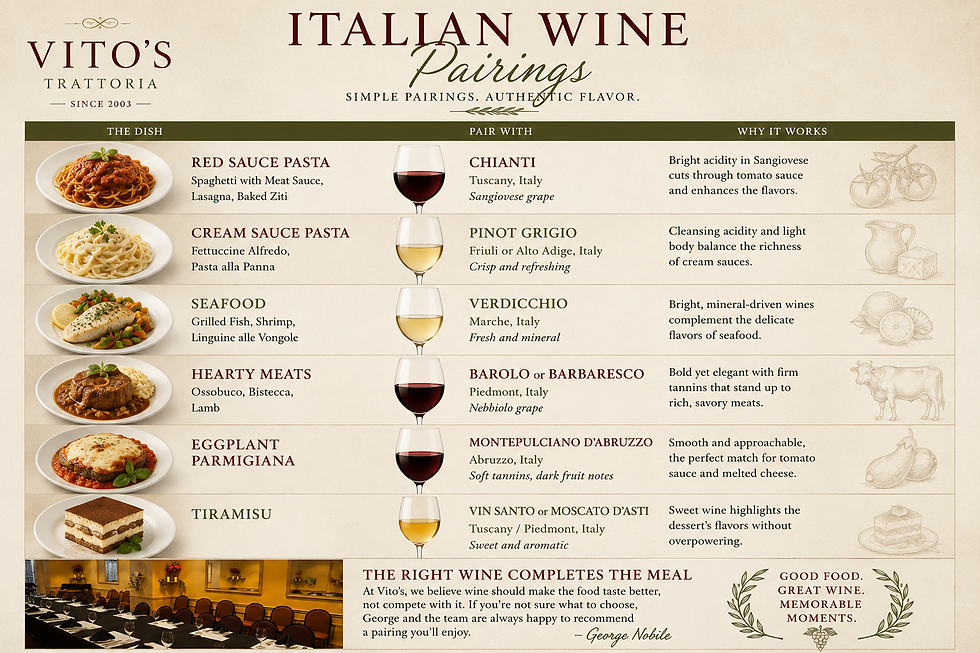
Red Sauces, Bold Pastas, and Sangiovese
Tomato-based dishes call for wines with enough acidity to match the sauce. A wine that is lower in acid will taste flat alongside a marinara or an Amatriciana, the way a squeeze of lemon disappears into a dish that is already acidic.
Sangiovese is the grape to reach for. It is the backbone of Chianti and many of Tuscany's best-known red wines. Naturally high in acidity, it pairs well with tomato sauce without overpowering the dish. For heartier pasta dishes, a Chianti Classico is a dependable choice. Montepulciano d'Abruzzo, made from a different grape entirely but similar in character, is another strong option and is usually easier to find at a lower price.
Creamy Sauces, Risotto, and White Wine
Dishes built on cream, butter, or cheese need a wine with enough body to hold up to the richness but enough acidity to keep the palate from feeling coated.
Pinot Grigio from Friuli or Alto Adige is the straightforward answer. It is crisp, light-bodied, and clean without being watery. Soave, made from the Garganega grape in the Veneto, is a slightly richer option with a faint almond note that works particularly well with gorgonzola sauces and risotto. George has always believed a good bottle of wine should make the food taste better, not compete with it. Both of these do exactly that.
Chicken marsala is a slightly different case. The wine in the sauce is the dominant flavor, and a dry Marsala or a medium-bodied Sicilian white like Grillo will echo it without competing. A light red such as a Cerasuolo di Vittoria also works if you prefer red with chicken.
Seafood and the Wines of Coastal Italy
The standard advice with seafood is white wine, and for Italian food that advice holds.
For grilled or pan-seared fish in a white wine and garlic sauce, such as the salmon or petrale sole at Vito's, Vermentino from Sardinia is a strong match. It has a slightly saline, herbaceous quality that works naturally with both the fish and the sauce. Falanghina from Campania is another option, a little fuller, with stone fruit and citrus notes that suit lighter preparations. If neither is on the list, Pinot Grigio is always a reliable fallback.
For a dish like frutti di mare, where you have clams, mussels, calamari, and prawns in a tomato base, look for a crisp Italian white with enough acidity to bridge the brine of the shellfish and the sharpness of the sauce. Pinot Grigio handles it well, or ask the staff what they are pouring by the glass.
Veal, Ossobuco, and the Wines of Northern Italy
Ossobuco is braised veal shank, slow-cooked until the collagen breaks down into the sauce. It is one of the richest dishes in the Italian canon, and it comes from Milan. The traditional pairing reaches next door to Piedmont, which is Nebbiolo country.
If you are ordering the ossobuco at Vito's, Nebbiolo-based wines such as Barolo or Barbaresco are the classic Italian pairing, and for good reason. Both come from Piedmont and have high tannin, high acid, and flavors of tar, dried rose, and red fruit that are built to cut through braised meat and its cooking liquids. A Barolo needs a few years of age to soften, so if you are ordering off a restaurant list, a Barbaresco or a Langhe Nebbiolo is often the more approachable option at dinner.
For veal preparations that are lighter, such as piccata or saltimbocca, a Barbera d'Asti is a better fit. Lower in tannin than Nebbiolo, high in acid, with a clean dark fruit profile that does not overwhelm a dish built on lemon and capers.
Dessert Wines: How the Italians Finish the Meal
Italian dessert wines are their own category, and they follow a rule worth knowing: the wine should always be at least as sweet as the dessert it accompanies. A dry wine served with a sweet dish will taste sour and thin. A wine sweeter than the dish will overwhelm it. The goal is a match or a slight edge toward the wine.
Moscato d'Asti from Piedmont is the most versatile Italian dessert wine. It is lightly sparkling, low in alcohol, with peach, apricot, and orange blossom notes that pair well with fruit-based desserts, lemon cake, creme brulee, and anything that finishes light. The effervescence helps clean the palate between bites.
Vin Santo is the traditional Tuscan pairing for cannoli and biscotti. It is an amber-colored, oxidatively aged wine with notes of dried fruit, honey, and almond. The combination of Vin Santo and cannoli is one of the oldest dessert pairings in Italian dining, and it holds up because the wine's nuttiness and the ricotta filling share the same register.
For chocolate-based desserts, Brachetto d'Acqui is the Italian answer. It is a lightly sparkling red from Piedmont with strawberry and rose notes, low tannin, and just enough sweetness to hold up against chocolate mousse or a chocolate cake without tasting like candy. It is less familiar than Moscato, but if it is on the list, order it.
For tiramisu specifically, the espresso in the dessert complicates most wine pairings. A small glass of Marsala, which is fortified and has some of the same roasted, caramel notes as espresso, is the classic Italian choice. It does not fight the coffee; it joins it.
A Great Meal Deserves the Right Glass
One of the pleasures of dining at Vito's is slowing down long enough to enjoy a good meal with the right glass of wine. George and the team have always believed there is nothing wrong with ordering the wine you enjoy most. But if you want a
recommendation, just ask. They are always happy to point you toward a pairing you will love.
Vito's Trattoria serves dinner Monday through Thursday from 4:30 to 8:00 pm, Friday from 4:30 to 8:30 pm, and Saturday from 5:00 to 8:30 pm. Reserve a table at myvitos.com or call 408-453-1000.


Comments